
Vertical farms, grow rooms & cold stores
Horticulture & Vertical Farming
Indoor farms control the light, water and nutrients. The air is often left to chance. We continuously break down the ethylene and mould spores that shorten the life of a crop.
97%
Surface mould reduction
5 days, 750+ field test, commercial office
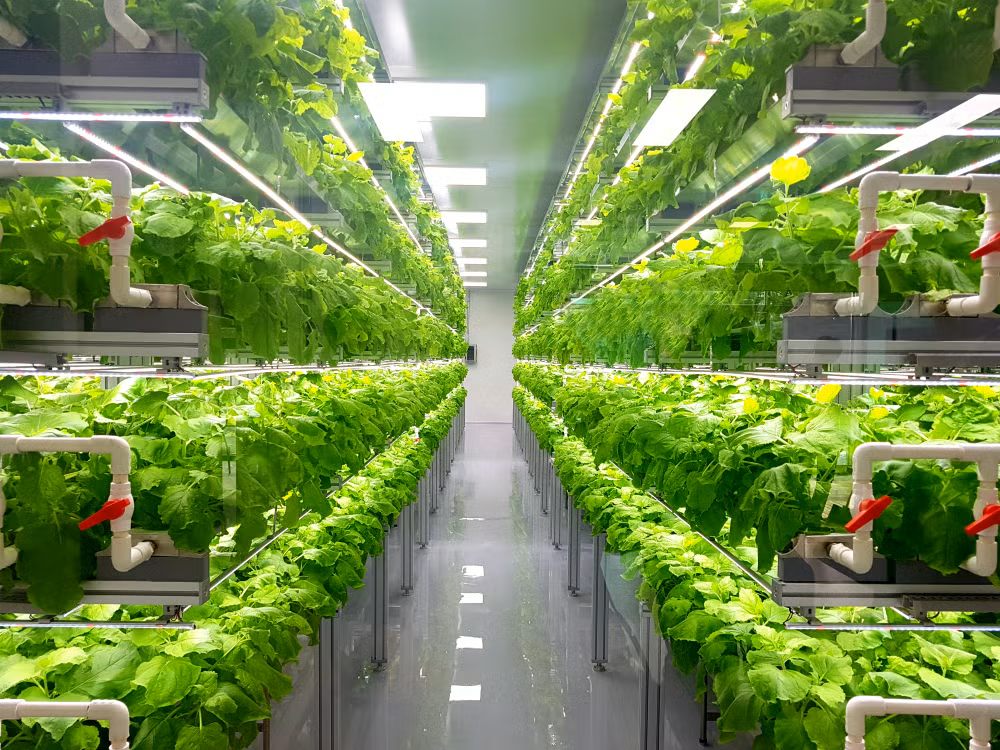
Indoor and vertical farms control almost everything: light, water, nutrients and temperature. The air is the variable most often left to chance. Grow rooms run warm and humid, plants are packed densely, and the same air recirculates for weeks. Those are exactly the conditions mould spores need, and once grey mould (Botrytis) or powdery mildew takes hold, it can move through a closed room quickly.
There is a second, invisible problem: ethylene. Plants and ripening produce release this gas, and it acts at trace levels, around 0.1 parts per million. It speeds ripening and ageing, yellows leafy greens, makes flowers and leaves drop and shortens shelf life. Research has also linked raised ethylene to more Botrytis infection in flowers. In a sealed room it builds up with nowhere to go.
Our systems use advanced photocatalytic oxidation to produce hydroxyl radicals, the same molecules that clean the air outdoors. Hydroxyls break ethylene down into carbon dioxide and water. The method traces back to NASA-funded research into keeping ethylene down in sealed plant-growth chambers, and a photocatalytic ethylene scrubber first flew on the Space Shuttle in 1995.
The same chemistry breaks down mould spores, bacteria and odours in the air and on surfaces, around the clock. In five-day field tests, the 750+ cut surface mould by 97% across a working office, and the PTAC removed more than 99.99% of mould from fan and coil surfaces. In a grow room, that means fewer spores circulating between plants and cleaner fans, coils and ducts. There are no sprays and no residue on the crop, and it works alongside good humidity control, airflow and hygiene rather than replacing them.
The benefit carries on after harvest. Lower ethylene and fewer airborne spores in packing areas and cold stores help produce stay fresh for longer on its way to market. That matters in the UAE, where vertical farming is central to the National Food Security Strategy 2051, and where Dubai's Bustanica opened in 2022 as the world's largest vertical farm.
What matters here
Botrytis and powdery mildew
Warm, humid, densely planted rooms are where airborne spores spread fastest.
Ethylene build-up
A trace gas that ages crops early, yellows greens and cuts shelf life in sealed rooms.
Post-harvest and cold storage
Packing areas and cold rooms, where spores and ethylene shorten the life of finished produce.
Odours and working conditions
Plant VOCs and damp, musty smells in the rooms where staff work all day.
Typical specification
Where we'd usually start for horticulture & vertical farming.
Indicative only. The final specification follows the site assessment, and depends on served volume and how the space is actually used.


Get in touch
Start with the building, not a quote.
We begin by understanding the environment and what's actually driving the problem: the building, the air handling, and how the space is really used. What you get back is a specification built around that, not a quote against a template.
- 1
We review what you've told us and come back within one working day.
- 2
A site assessment covering the space, the air handling system, and what's actually driving the problem.
- 3
A written specification and a fixed price, including the ongoing service interval.
Dubai, United Arab Emirates